
AI Alt Text Generator for Digital Marketing
Uncategorized

Why Digital Marketing Matters for Business?

In today’s highly connected world, digital marketing has become one of the most powerful tools for business growth. Whether you run a small local business, an e-commerce store, a startup, or a large enterprise, having a strong online presence is no longer optional—it is essential. Consumers now spend a significant portion of their time online, using search engines, social media platforms, websites, and mobile applications to discover products, compare services, read reviews, and make purchasing decisions. Digital marketing helps businesses connect with these potential customers at the right time and through the right channels. Unlike traditional marketing methods that often require large budgets and offer limited tracking capabilities, digital marketing provides measurable, cost-effective, and highly targeted strategies that deliver real business results. One of the biggest advantages of digital marketing is its ability to reach a larger audience. Traditional marketing channels such as newspapers, radio, and billboards are often limited by location and audience size. Digital marketing removes these barriers by enabling businesses to reach customers across cities, countries, and even global markets. Through search engine optimization (SEO), social media marketing, email campaigns, content marketing, and paid advertising, businesses can increase their visibility and attract customers who are actively searching for their products or services. This expanded reach creates new opportunities for growth and allows businesses to compete effectively regardless of their size. Another key reason digital marketing matters is its ability to target specific audiences. Modern digital platforms offer advanced targeting features that help businesses reach people based on demographics, interests, behaviors, location, and online activities. For example, a local business in Malappuram can display advertisements only to users within a specific geographic area, while an online store can target customers who have previously visited its website. This precision ensures that marketing budgets are spent more efficiently and that promotional messages are shown to the most relevant audience. As a result, businesses can improve conversion rates and generate higher returns on investment. Search Engine Optimization (SEO) plays a crucial role in digital marketing success. When customers need information, products, or services, they often begin their journey with a search engine such as Google. Businesses that appear on the first page of search results have a significantly higher chance of attracting traffic and generating leads. SEO involves optimizing website content, improving site performance, using relevant keywords, and creating valuable resources that match user intent. A well-optimized website not only improves visibility but also builds trust and credibility. Customers are more likely to choose businesses that rank highly in search results because they perceive them as authoritative and reliable. Content marketing is another essential component of digital marketing. Today’s consumers seek information before making purchasing decisions. By creating high-quality blog posts, articles, videos, infographics, guides, and social media content, businesses can educate their audience while establishing themselves as industry experts. Valuable content helps answer customer questions, solve problems, and build long-term relationships. It also supports SEO efforts by increasing website traffic and improving search rankings. Businesses that consistently provide useful content are more likely to earn customer trust, encourage engagement, and generate qualified leads over time. Social media marketing has transformed the way businesses communicate with their audience. Platforms such as Facebook, Instagram, LinkedIn, YouTube, and X allow brands to interact directly with customers, share updates, promote products, and build communities around their services. Social media creates opportunities for two-way communication, enabling businesses to receive feedback, respond to inquiries, and strengthen customer relationships. A strong social media presence helps increase brand awareness, improve customer loyalty, and drive website traffic. Additionally, social media advertising offers advanced targeting options that help businesses reach specific audiences with highly relevant messages. Digital marketing is also highly cost-effective compared to traditional advertising methods. Small and medium-sized businesses often face budget limitations, making it difficult to compete with larger companies through traditional media. Digital marketing levels the playing field by offering affordable promotional options that can be scaled according to business needs. For instance, businesses can start with a modest advertising budget on Google Ads or social media platforms and gradually increase their investment as they see positive results. Because digital campaigns can be tracked and optimized in real time, businesses can make data-driven decisions and avoid wasting money on ineffective strategies. One of the most valuable aspects of digital marketing is its measurability. Unlike traditional marketing campaigns, where results can be difficult to track, digital marketing provides detailed analytics and performance insights. Businesses can monitor website traffic, user behavior, conversion rates, click-through rates, engagement levels, and many other metrics. Tools such as Google Analytics, Google Search Console, and advertising platform dashboards help marketers understand what is working and what needs improvement. This data-driven approach allows businesses to refine their strategies, improve campaign performance, and achieve better outcomes over time. Customer engagement is another area where digital marketing excels. Modern consumers expect brands to be accessible, responsive, and interactive. Through email marketing, social media communication, chatbots, and personalized content, businesses can maintain ongoing relationships with their audience. Email marketing, in particular, remains one of the most effective digital marketing channels because it enables direct communication with potential and existing customers. Personalized email campaigns can nurture leads, promote special offers, share valuable content, and encourage repeat purchases. Strong customer engagement leads to increased trust, higher retention rates, and long-term business success. The rise of mobile technology has further increased the importance of digital marketing. Smartphones have become an integral part of daily life, allowing consumers to browse products, search for information, and make purchases anytime and anywhere. Businesses that invest in mobile-friendly websites, responsive design, and mobile advertising can provide better user experiences and capture a larger share of the market. Mobile optimization is also a critical ranking factor for search engines, making it essential for businesses that want to improve their online visibility and performance. Digital marketing also supports brand building and reputation management. A strong online presence helps businesses establish a recognizable identity and communicate their values to potential customers. Through consistent messaging, professional website
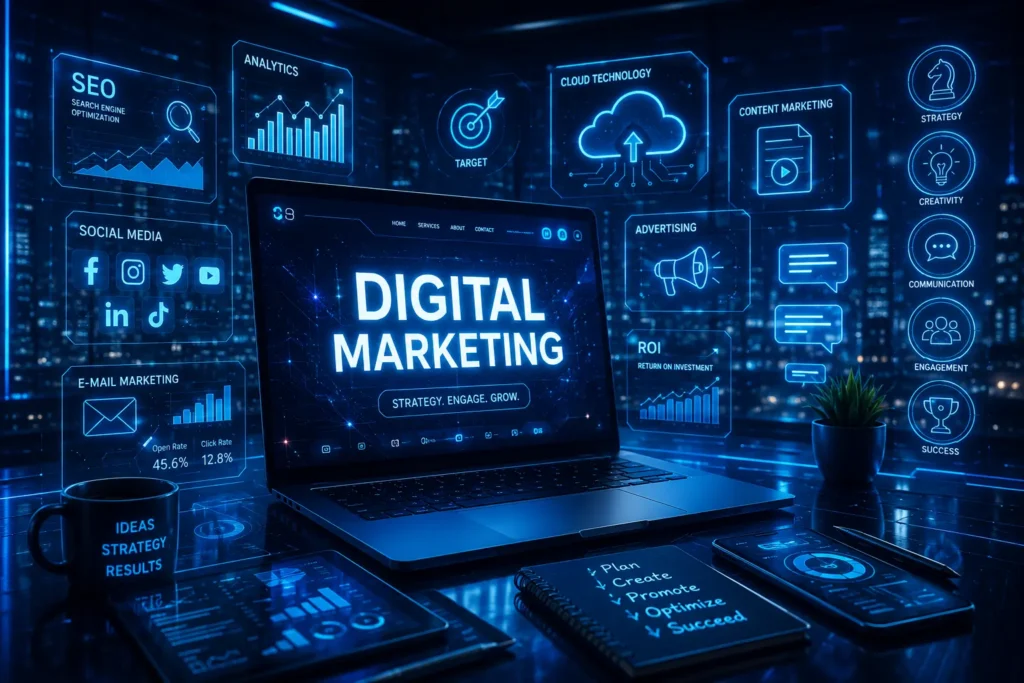
Best Digital Marketing Expert in Malappuram monitoring SEO performance, content strategy, and digital marketing analytics through advanced marketing dashboards.
Uncategorized

What Should a Business Measure in Digital Marketing?

Running digital marketing campaigns without tracking the right numbers is like driving with your eyes closed. You might be moving, but you have no idea if you’re headed toward growth or straight into a wall. Many businesses pour money into SEO, Google Ads, and social media without ever pausing to ask, “What should we actually be measuring?” The truth is, not every metric matters equally. Some numbers look impressive on a dashboard but say nothing about real business growth. Others are less flashy but tell you exactly whether your marketing is working. This guide breaks down the metrics that genuinely matter, organized by channel and by business goal, so you can stop guessing and start making decisions based on data. Why Measurement Matters More Than Ever Digital marketing gives you something traditional advertising never could: the ability to track almost every action a customer takes. A billboard can’t tell you how many people saw it and then bought your product. A well-tracked digital campaign can. But that advantage only helps if you know which numbers to watch. Measuring the wrong things leads to wasted budgets, misguided strategies, and decisions based on vanity rather than value. Measuring the right things helps you double down on what works, cut what doesn’t, and prove the value of marketing to stakeholders. 1. Website Traffic and Its Quality Traffic is often the first metric businesses check, and for good reason—it shows whether people are finding you at all. But raw visitor numbers only tell part of the story. What matters more is where that traffic comes from and how it behaves once it arrives. Break your traffic down by source: organic search, paid ads, social media, referrals, and direct visits. This tells you which channels are actually pulling their weight. Pair this with engagement indicators like average session duration, pages per visit, and bounce rate. A page that gets thousands of visits but loses everyone in five seconds is not a win—it’s a warning sign that your content or targeting needs work. 2. Conversion Rate Traffic without conversions is just noise. Conversion rate—the percentage of visitors who complete a desired action, whether that’s a purchase, a form submission, a call, or a newsletter signup—is one of the clearest indicators of whether your website and campaigns are actually doing their job. Track conversion rate at multiple levels: overall site conversion rate, conversion rate by traffic source, and conversion rate by landing page. This layered view helps you spot exactly where the funnel is leaking. If your Google Ads traffic converts well but your organic traffic doesn’t, that’s a signal to look at how each audience is being targeted and served. 3. Cost Per Acquisition (CPA) Cost per acquisition tells you how much you’re spending, on average, to gain one paying customer or one qualified lead. This is one of the most important numbers for judging whether a campaign is financially sustainable. A campaign might generate plenty of clicks and even a fair number of conversions, but if the cost per acquisition is higher than what that customer is worth to your business, you’re losing money with every sale. Tracking CPA across different platforms—Google Ads, Meta Ads, and organic efforts—lets you compare true efficiency, not just surface-level performance like click volume. 4. Return on Ad Spend (ROAS) and Return on Investment (ROI) While CPA tells you the cost side of the equation, ROAS and ROI tell you the return side. ROAS measures revenue generated for every unit of currency spent on advertising, while ROI takes a broader view, factoring in total costs, including labor, tools, and overhead, against total profit generated. For a business running Google Ads or Meta Ads campaigns, ROAS is often the number that decides whether a campaign continues, scales up, or gets paused. A campaign with high traffic and decent conversions can still be a failure if the ROAS shows you’re spending more than you’re earning back. 5. Customer Lifetime Value (CLV) Many businesses focus so heavily on acquisition metrics that they forget to measure what happens after the first purchase. Customer Lifetime Value estimates the total revenue a business can expect from a single customer over the entire relationship, not just their first transaction. This metric matters because it changes how you interpret acquisition costs. A CPA that looks expensive on paper might actually be reasonable if customers tend to stick around and make repeat purchases for years. Businesses that track CLV alongside CPA make smarter long-term decisions about how much they can afford to spend on acquiring new customers. 6. Search Engine Rankings and Organic Visibility For businesses investing in SEO, keyword rankings remain a foundational metric, but they should never be viewed in isolation. Ranking on page one for a keyword nobody searches for is meaningless. What matters is ranking for keywords that align with buyer intent and actually drive qualified traffic. Alongside rankings, monitor organic impressions, click-through rate from search results, and how many keywords you rank for over time. Tools that report on search visibility help confirm whether your SEO efforts are compounding month over month, since SEO growth is rarely instant and needs to be tracked over a longer window than paid campaigns. 7. Ad Platform-Specific Metrics Each advertising platform has metrics unique to how it functions, and these deserve attention alongside the broader business metrics above. For Google Ads, keep an eye on quality score, click-through rate, and impression share, since these directly affect how much you pay per click and how often your ads even get shown. For Meta Ads, metrics like frequency, relevance score, and cost per thousand impressions (CPM) reveal whether your creative is resonating or whether audience fatigue is setting in. Ignoring these platform-level signals often means missing early warnings before they show up as wasted spend. 8. Customer Acquisition Channels and Attribution As businesses run campaigns across multiple channels simultaneously, understanding which channel actually deserves credit for a conversion becomes essential. This is where attribution modeling comes in—deciding whether the

Illustration explaining what an SEO service is, by the Best Digital Marketing Expert in Malappuram
Uncategorized

Why Is SEO Important for Business?

If you run a business today—whether it’s a local shop, a service provider, or an online store—chances are your customers are searching for you on Google before they ever pick up the phone or walk through your door. Search Engine Optimization (SEO) is the practice of making sure your business actually shows up when they do. It’s no longer an optional marketing tactic; it’s a core part of how businesses grow, compete, and build trust online. Let’s break down exactly why SEO matters so much and why ignoring it can quietly cost you customers every single day. 1. Most Buying Journeys Start with a Search Think about the last time you needed a product, service, or answer to a question. There’s a good chance you opened Google before you asked a friend or visited a shop directly. Studies consistently show that the majority of consumers research products and services online before making a purchase decision—even for things they eventually buy offline. If your business doesn’t appear in those search results, you’re invisible to a huge portion of potential customers at the exact moment they’re ready to buy or inquire. SEO ensures your website is positioned to capture that intent when it matters most. 2. It Builds Long-Term, Sustainable Traffic Unlike paid ads, which stop generating traffic the moment you stop paying, SEO builds an asset that keeps working for you over time. A well-optimized page that ranks on page one of Google can continue driving visitors, leads, and sales for months or years with minimal ongoing investment. This compounding effect is one of the biggest reasons SEO is considered a smart long-term marketing investment. Early effort in optimizing your website, publishing helpful content, and earning quality backlinks pays dividends well beyond the initial work. 3. SEO Builds Trust and Credibility Ranking high in organic search results isn’t just about visibility—it’s also a trust signal. Most users perceive top-ranking websites as more credible and authoritative than those buried on page two or three. There’s also a natural bias against paid ads; many users actively skip sponsored listings and click organic results instead because they view them as more genuine. When your business consistently appears at the top for relevant searches, it reinforces the perception that you are an established, trustworthy option in your industry—even before a visitor lands on your website. 4. It Levels the Playing Field for Small and Local Businesses One of the most powerful aspects of SEO, especially local SEO, is that it doesn’t require a massive advertising budget to compete. A small business with well-optimized content, accurate local listings, and strong customer reviews can outrank larger competitors for location-specific searches like “best bakery near me” or “affordable visa consultant in Dubai.” This is particularly relevant for local and regional businesses that don’t have the budget to compete with national brands on paid advertising. SEO allows them to compete on relevance and quality of content rather than ad spend alone. 5. SEO Improves the Overall User Experience Modern SEO isn’t just about keywords and backlinks—it’s deeply tied to how well your website actually functions. Search engines like Google prioritize sites that load quickly, work well on mobile devices, have clear navigation, and provide genuinely useful content. This means that investing in SEO often forces improvements that benefit your business regardless of search rankings: a faster website, a smoother mobile experience, and content that actually answers customer questions. These improvements reduce bounce rates, increase time on site, and ultimately lead to more conversions. 6. It Provides Measurable, Data-Driven Insights SEO isn’t a guessing game. Tools like Google Search Console and Google Analytics allow businesses to see exactly which keywords are driving traffic, how users are interacting with their website, and where there’s room for improvement. This data helps businesses understand what their customers are actually searching for, which can inform not just marketing but also product development, customer service, and content strategy. Rather than relying on assumptions about what customers want, SEO data offers direct evidence based on real search behavior. 7. It Supports Every Other Marketing Channel SEO doesn’t operate in isolation—it strengthens your entire digital marketing ecosystem. A well-optimized website makes your paid ad campaigns more effective by improving landing page quality scores. Content created for SEO purposes can be repurposed for social media and email marketing. Positive search visibility reinforces brand recognition, which improves the performance of retargeting campaigns. In short, SEO acts as the foundation upon which other marketing efforts can build, rather than a standalone tactic competing for the same budget. 8. Your Competitors Are Already Doing It If your business operates in a competitive space — and most do — there’s a strong chance your competitors are already investing in SEO. Every day that your website isn’t optimized is a day competitors could be capturing customers who would have otherwise found you first. Businesses that delay SEO often find themselves playing catch-up, needing significantly more time and effort to outrank competitors who started earlier and have already built domain authority and content depth. 9. It Adapts to Changing Consumer Behavior Search behavior continues to evolve—from voice search to AI-powered search assistants to mobile-first browsing. Businesses that invest in SEO are better positioned to adapt to these shifts because good SEO practices (clear content, fast websites, structured data, and genuine expertise) tend to remain relevant even as search algorithms and platforms change. Ignoring SEO means risking obsolescence as more of your potential customers rely on search-driven discovery rather than traditional advertising or word of mouth.

Scroll to Top